

Howard Hughes - Part 2

Last week I wrote about Howard Robard Hughes Jr. and how, for a time, he became the world’s most famous aviator. After breaking several aviation records in the 1930s, he turned his attention and his need for control to the building of an airline, an airliner and a revolutionary warplane.
Airlines
In January of 1939, Howard Hughes met with Jack Frye. He was a pilot who had risen to become president of TWA, though he still sometimes flew routes for the airline. Frye was having difficulties with the principal stockholder and was thinking about working for Hughes instead.
Howard came up with a plan of his own. Through the Hughes Tool Company he bought 99,293 shares at $8.25 each, even though he’d promised Frye he’d pay $10. Later, Hughes bought another $1,500,000 worth of stock. By 1940 he had a controlling interest and would end up owning 78% of the airline.
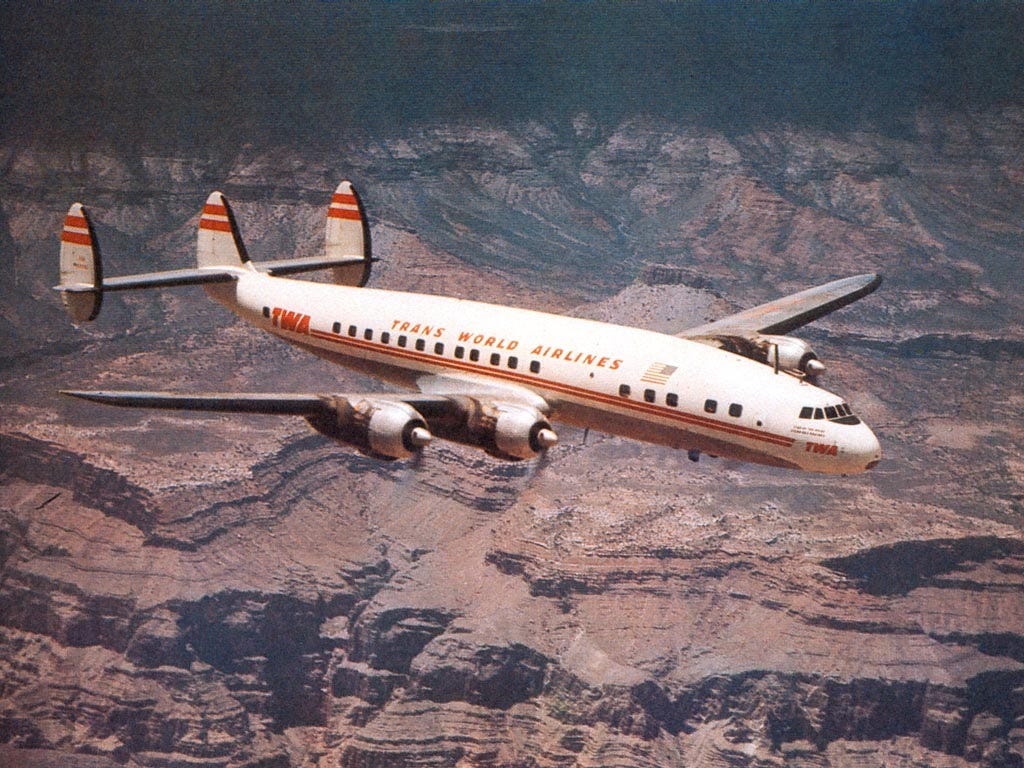
Together, Frye and Hughes developed the specifications for a new transport aircraft that could carry forty-four passengers at over 250 miles per hour for 3,500 miles. It was to be built by Lockheed and called the Constellation.
Constellation
The first prototype flew in January 1943, with Boeing test pilot Eddie Allen in the captain’s seat and Lockheed’s Milo Burcham as co-pilot. By now, though, it was designated the C-69 as the United States had finally joined the war which everyone else had been fighting for years, and decided that the Connie would make an excellent troop transport, able to ship large numbers of cannon fodder across the Atlantic faster than anything else.
Milo Burcham should have been the first to fly the second prototype, but that honour went to Howard Hughes, who had played a part in its design. Burcham was, once again, relegated to the right-hand seat. Also on board were TWA president Jack Frye and Lockheed’s chief engineer, Kelly Johnson. Johnson would go on to design, among many other post-war aircraft, the U-2 and SR-71 spyplanes.
It was a year before they were ready to reveal the Constellation to the rest of the world. On 17 April 1944, Hughes departed Burbank in the second Constellation prototype and landed in Washington, DC less than seven hours later. It was another transcontinental speed record, but this time in a production airliner. It showed the world the shape of things to come.
During the tour to show off the new airliner that followed, they stopped in Vandalia, Ohio, where a seventy-two-year-old pilot – and distant cousin of Hughes – took the right-hand seat for a short flight. During that flight, he commented that the wingspan of the Constellation was longer than the distance of the first flight he had made. That had been back in December 1903, and the pilot’s name was Orville Wright. This would be his last flight as a pilot.
The inaugural commercial TWA flight of the Constellation – in this case one named Star of California – took place on 15 February 1946 and carried thirty-five passengers, including several real stars of California: Cary Grant, Veronica Lake, Myrna Loy, Walter Pidgeon (which was a bit of a coup), Tyrone Power and Edward G. Robinson. It took eight hours and thirty-eight minutes to fly from Los Angeles to New York City, slashing the time taken by the competitors’ DC-4s by at least a third.
The War Years
Hughes wanted to be involved in the war effort, even before the United States joined the war. He proposed to build a big, twin-engined, boom-tailed pursuit ship built of Duramold plastic-bonded plywood. It was designated the D-2.
As early as 1940, he had bought 1,300 acres just west of Culver City, California – land that is now part of the sprawl of Los Angeles. On first seeing the area from the air he had told Noah Dietrich to buy it “and everything that is vacant nearby to keep people from getting too close to my airport.” Here they built the longest private grass airstrip in the world. By the spring of 1941, five hundred people were employed at the sixty-thousand-square-foot, air-conditioned Culver City plant.
Hughes spent $2 million of Hughes Tool Company money building the factory to produce the aeroplane and another $2 million on the prototype aircraft itself. The test pilot was, of course, Howard Robard Hughes Jr., but it did not fly well.
In August 1943, Colonel Elliott Roosevelt led the team tasked with evaluating several aircraft projects. He submitted a report on the D-2 saying that, with some modifications to make it a reconnaissance aircraft, a small number of these aeroplanes would win the war within six months. On 11 October 1943, a letter of intent was signed for one hundred F-11s, the derivative of the D-2 and later designated the XF-11, at a cost of $700,000 each.
The money spent by Hughes on developing the aircraft had been important, but the money spent entertaining the team was probably just as crucial in securing the contract. During the inspection team’s visit to California, Elliott Roosevelt was introduced to the actress Faye Emerson, whom he would later marry. Of course, it couldn’t have hurt that Elliott’s father was Franklin Delano Roosevelt, the longest-serving president in US history.
Car Crash
Hughes had three severe automobile accidents in his life. He was seriously injured in the third of these, which took place on 7 May 1944 in Los Angeles. As Hughes was making a left-hand turn, another car crashed into him. His head hit the windscreen and he suffered a serious head injury – far from his first and, unfortunately, not his last.
His first head injury was in the crash of the Thomas-Morse S-4 Scout during the filming of Hell’s Angels in the 1920s. Then there had been a crash of the Sikorsky S-43 he was piloting in 1943, which resulted in the deaths of CAA inspector Ceco Cline and Hughes employee Richard Felt.
Now, after recovering physically from this latest car crash, Hughes needed time to recover mentally. To do that he did what he always did to feel most alive: he went flying. Specifically, he flew the repaired Sikorsky S-43 amphibian around the United States, seemingly with no planned routes or places to stop, going where the mood took him.
It would be the autumn of 1945 before he returned to the Culver City plant where his aircraft were being built. Without his input for a year or more, there had been little progress on the F-11 (now known as the XF-11) and on the aircraft for which he would probably become best known.
XF-11
During the Fourth of July weekend in 1946, Howard Hughes accepted an invitation to a party hosted by James Cagney’s brother, Bill, at his home in Newport Beach, California. The most decorated US soldier of the Second World War – in fact the most highly decorated enlisted soldier in US history – was there. His name was Audie Murphy and the twenty-one-year-old was now trying to become an actor and break into the movies, having recently been signed by the production company owned by Bill and James Cagney. He was there with his nineteen-year-old girlfriend, Jean Peters.
On the morning of 7 July, as the party was coming to an end, Hughes suggested that he fly Murphy, Peters and Bill Cagney to Culver City, where he was due to carry out a test flight of the XF-11 prototype, tail number 44-70155. The twin-boom, twin-tail, twin-engined aircraft was now powered by two Pratt & Whitney R-4360 engines, each producing 3,000 hp and driving a set of contra-rotating four-bladed Hamilton Standard propellers.
At 5:20 that afternoon, Hughes took off from the massive grass runway at the Culver City plant. Glenn Odekirk and Hughes’ flight test engineer, Gene Blandford, took off shortly afterwards in a Douglas A-20G to act as a chase plane. They were instructed to take Bill Cagney and Audie Murphy with them. This was most likely not simply an act of kindness to show them this amazing first flight from the air, but more an attempt to part Murphy and his girlfriend so that beautiful brunette Jean Peters would be free to greet Howard Hughes after the successful flight and for his assistant to set up a date while he was airborne.
One hour and thirty-five minutes later, with the aircraft still airborne, an oil leak caused the right-rear propeller to go into reverse. Instead of landing immediately at Culver City, Hughes decided to remain airborne to diagnose the problem. To help him do this, he loosened his harness to enable him to look around more freely. By the time he realised that he was now too far from Culver City to make it back and too low to bail out, there was little he could do but aim for the open ground of the Los Angeles Country Club and its golf course.
His straps still loose, his body and head hit the canopy and parts of the cockpit as he crashed through an electricity transformer and the top storey of three houses. The last house, at 808 Whittier Drive, home of Lieutenant Colonel Charles Meyer, was nearly destroyed by the impact, as were the aircraft and Hughes himself.
He had burns on the left side of his body, lacerations, abrasions, bruises and contusions across his entire body. His left clavicle, a vertebra and three ribs were broken. He had haemorrhaging in his lungs, the left one collapsed, and damage to his heart when it was shifted to the right side of his chest cavity. He managed to crawl from the wreckage before being rescued by US Marine Corps Master Sergeant William L. Durkin, whom Hughes sent $200 a month for the rest of his life by way of thanks. However, when Durkin finally left the service and tried to contact Hughes for help in setting up a business, Hughes did not return his calls.
Whilst in hospital, Hughes re-designed his hospital bed, getting engineers to create a bed that used electric motors to move separate parts of the frame and make the patient comfortable. It was the prototype for the sort of beds still used in hospitals worldwide today. It may also have been while recovering from his horrific injuries that he was introduced to codeine. However, Noah Dietrich, who was as close to him as anybody at this point in his life, later said that Hughes refused anything to alleviate the pain.
The US Army would later conclude that the accident was avoidable after the malfunction of the propeller and put the cause down to pilot error. They were also set against Hughes flying the second prototype. In this, they lost. Hughes was more powerful than the US Army. However, they did insist that the later test flights took place in a less inhabited area. It was less than nine months later that Hughes flew the second prototype, 44-70156, from Muroc Dry Lake in the Mojave Desert on 5 April 1947. The aircraft, now with more conventional propellers, flew for an uneventful ninety minutes.
Most of the test flying of this aircraft was done by Hughes, with Gene Blandford as flight test engineer, though Blandford finally refused to fly with Hughes, having been scared by him during some of the final flight tests. On 1 November 1947, the XF-11 was officially handed over to the US Air Force. However, the original order for ninety-eight aircraft had been cancelled when the war ended two years earlier, and this prototype was used as a test aircraft for less than two years before being scrapped.
ToolCo
By the end of the Second World War, production processes at the Hughes Tool Company were outdated at best, antiquated at worst. Hughes sent Noah Dietrich to Houston to take charge. Dietrich spent $5 million bringing the plant up to date – and profits soared. Their biggest profit in history to date had been $6 million; now they rose to $9 million. Then came an annual return of $13 million, then $22 million, and so on. In the eight years following Dietrich’s takeover, ToolCo produced profits of $285,000,000. No dividends were ever distributed and Howard Hughes drew a salary of just $50,000. However, everything he ever purchased was expensed to his father’s company.
Next week I’ll look at one of Hughes’s companies that was never part of Toolco, and at how he now turned his attention and his need for control to building a bigger airline and the biggest aeroplane the world had ever seen. That post will go out a little later in the day at the, seemingly, oddly specific time of 13:27 BST. Don’t forget to put your clocks forward.