

Howard Hughes - Part 1

Over the next four weeks, mainly on Sundays and at seemingly oddly specific times, I’ll be publishing a short series of posts about one of the most fascinating characters of the twentieth century: Howard Hughes. For all the money, women, hotels and casinos, Hughes only ever really cared about two things: flying and control. This is the story of how he gained both – and how, slowly, he lost them.
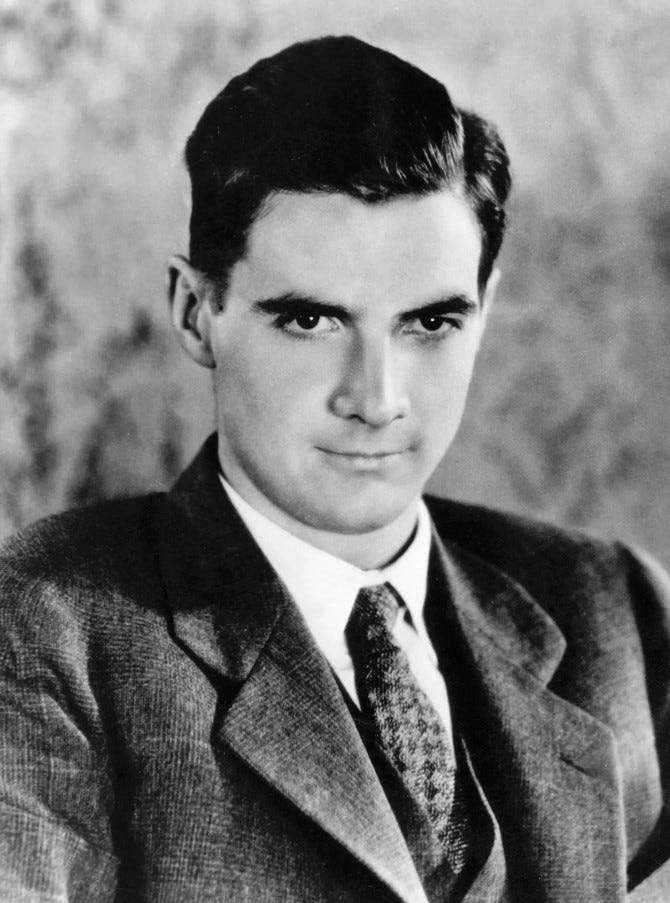
Howard Robard Hughes Jr. was born sometime in 1905. An affidavit birth certificate created in 1941 says he was born on Christmas Eve, but his baptismal record has his birth three months earlier. This kind of confusion, obfuscation and mystery would surround a great deal of his life.
First Flight
In 1901, at the age of thirty-two, Harvard dropout Howard Robard Hughes Sr. moved to Texas in the hope of striking it rich in the oil boom. Eight years later, now with a wife and young son to support, he co-founded the Sharp-Hughes Tool Company and patented a revolutionary drill bit for the oil industry. Following the death of his business partner, Walter Sharp, in 1912, Hughes negotiated the purchase of stock in the company from Sharp’s relatives who had inherited it. He was sole owner of the company by 1918. Though Howard Jr.’s mother is often considered to be the biggest influence in his life, this behaviour suggests that his father played a bigger part than is often acknowledged, as we will see.
In the autumn of 1920, Howard Sr. took his only son to watch the Yale–Harvard boat race held in New London, Connecticut. He promised the fourteen-year-old boy any present at all if his alma mater won. They did, and Howard Jr. asked his millionaire father for five dollars. This was the price of a flight in a Curtiss flying boat anchored in New London harbour.
The following year, Howard Senior wanted to enrol his son in the Thacher School in California, but it was full. He wrote to the principal stating that he never liked “to give up once I start to accomplish any definite thing” and offered to fund the building of a new dormitory. Howard Junior got a place in the school – another example of the way he himself would live his life.
Orphan
Howard’s mother, Allene Stone Hughes, née Gano, went into hospital for minor surgery in the spring of 1922. She never regained consciousness. Howard Senior begged her younger sister Annette Gano not to marry and, instead, to come and live with them and raise Howard. She agreed, and they all moved to the West Coast, perhaps to get Annette away from her fiancé. She and Howard shared a bungalow in a hotel in Pasadena. Howard Senior stayed at the Ambassador Hotel in Los Angeles. Weekends were often spent at the home of Howard Senior’s brother, Rupert, a movie producer. Howard Junior’s life was being mapped out right here.
In 1923, Annette left to return to Houston and marry. On 14 January 1924, Howard Senior had a heart attack and died. By the age of nineteen, Howard Robard Hughes Jr. was an orphan and a millionaire, having been left 75% of the stock in the Hughes Tool Company in his father’s will. The will, made eleven years earlier, left 25% to Howard and 50% to his mother but, as she had pre-deceased her husband, her share passed to young Howard. The remaining 25% had been left to Howard Sr.’s parents and his brother Felix. Howard Senior had written a new will giving Howard Junior a smaller share, but he never signed it. Within a few months, despite their continued protests, Howard had bought out his relatives’ shares in the company for $325,000 and was the sole shareholder.
At the time of his father’s death, Howard was a student at Rice University, but soon left as he wished to make a name for himself in other ways. Knowing that his future was assured and certain that it didn’t include running a tool company, Howard hired thirty-six-year-old accountant Noah Dietrich at $10,000 a year to run the business for him.
In 1925 he married Ella Botts Rice, great-niece of William Marsh Rice, for whom Rice University had been named. He had lured her to his bedside by getting his doctor to call her and tell her that Howard was seriously ill and kept calling her name. Hughes didn’t want a wife; he wanted to show his family that he was an adult – that is why they married.
Late in 1925, they lived in the Ambassador Hotel, where his father had stayed. The first few months of 1926 were spent living in Houston at the Hughes home at 3921 Yoakum Street. Howard was just there to wind up his affairs in Texas; his sights were set on Hollywood. At about this time, he told Noah Dietrich that he planned to become the world’s top golfer, Hollywood’s most famous film producer, a world-famous aviator and the richest man ever.
Learning to Fly
Howard Hughes left Noah Dietrich in charge of the Hughes Tool Company back in Houston, Texas, and moved with Ella to Los Angeles in April 1926 to start work on the second of his three planned goals: to become the world’s most famous movie producer. Another of his goals, though, was to become a first-class golfer, and he played every day at the Beverly Hills Country Club. One day a biplane flew overhead and tipped its wing. Hughes made a note of the aircraft’s registration and tracked the Waco aeroplane down to Clover Field. He offered the aircraft’s owner, J.B. Alexander, $100 a day to teach him to fly. Of course, Alexander said yes.
On 10 November 1927, Howard was issued private pilot’s licence No. 4223 and bought the first of his many aeroplanes, a three-seat, open-cockpit, Wright J-5-powered, 220 hp Waco 10 biplane, NC3574. However, Howard did not like being the 4,223rd anything and petitioned the Department of Commerce to reduce the number, which they eventually did, giving him licence number 80.
Movie Producer
The first movie for which Howard was a producer was the disastrous Swell Hogan, which was never even released as it was so bad. He was then the producer for the silent comedy Everybody’s Acting, which made a modest profit, and then the sparklingly successful Two Arabian Knights, directed by Lewis Milestone, who would win an Oscar for the movie at the very first Academy Awards ceremony. Milestone directed another movie for Hughes, The Racket, about Prohibition-era gangsters.
However, Howard’s attentions turned skywards. Aviation was now confirmed as a passion, and it was also going to be the subject of his next movie: a story of the air battles of the Great War, Hell’s Angels. After conflicts between Hughes and the first two directors, Marshall Neilan and Luther Reed, he hired Edmund Goulding as director but, in reality – and definitely for the aerial scenes – Howard was the director.
He spent $563,000 to buy and service eighty-seven aircraft and $400,000 buying and renting land in California to use as airfields. He owned and operated the largest private air force in the world. One problem with shooting the aerial scenes was that fast-moving aircraft looked static when filmed against the blue Californian sky. So the whole air force would have to take off and fly to where cumulus clouds were forecast to be. Hughes shot scenes over and over again. Aircraft and crew were sent to Oakland and sat it out for six months before the right kind of clouds were found.
A scene featuring the bombing of London by a Zeppelin was re-shot over a hundred times before he was content with it. When one scene was pronounced too dangerous by the lead stunt pilot, Hughes said that he would fly the stunt himself. Before the shoot had even begun, they were pulling an unconscious Hughes from the wreckage of the Thomas-Morse S-4 Scout aeroplane, one of nine which had been rounded up for the movie by Howard’s flying instructor, J.B. Alexander.
Just as production of the movie was drawing to a close, Al Jolson’s The Jazz Singer was released. This was the world’s first “talkie”, a movie with sound. Hughes could not release a silent movie now. In the end, all of the scenes where the actors spoke had to be re-shot and all the other scenes had sound added. The original female lead was the beautiful Norwegian movie star Greta Nissen. Unfortunately, her accent meant that she had to be replaced by an unknown actress called Jean Harlow. A fourth director, James Whale, was brought in to direct the scenes with dialogue.
The whole movie, and all three million feet of film, cost Howard Hughes three years of his life and $2.8 million, but he publicised it as costing $4 million. It also cost Hughes his marriage to Ella Rice, who had now moved back to Houston and filed for a divorce. The movie also took the lives of three pilots and a mechanic, killed during the filming of aerial sequences. On its initial release, receipts were around $2.5 million, making it a loss for the producer. However, it did make Jean Harlow a movie star.
Howard Hughes often found young actresses and attempted to turn them into movie stars. Sometimes – in fact quite often – his interest was more than merely professional. One such young actress was Billie Dove; however, she was already a star when they met. He signed her up to make five movies at $85,000 per movie. As talkies arrived, her voice and acting skills were not enough to keep her at the top of the movie business, but Howard didn’t care. The only thing that really worried him was Billie’s husband, Irvin Willat. Eventually Willat agreed to divorce Billie in exchange for three hundred and twenty-five one-thousand-dollar bills.
Howard took a deep interest in the two pictures she made, Cock of the Air and The Age for Love. Both of them were flops. He and Billie never did marry and she never did complete the five films. Howard then had a little more success with a movie called Sky Devils, starring Spencer Tracy and William Boyd, which found a use for the aircraft he’d purchased for Hell’s Angels. He had far more success with the movies where he did not meddle, and left the directors to do their own thing. The next two movies, The Front Page and Scarface, directed by Lewis Milestone and Howard Hawks respectively, were great successes. The only interference from Hughes was to veto the directors’ first choices of leading men. He felt that one actor had big ears which made him “look like a taxi-cab with both doors open”; the other was said by Hughes to be a “little runt”. Their names were Clark Gable and James Cagney.
A movie career which was kick-started by Hughes would come in 1939 when he produced The Outlaw, starring the unknown nineteen-year-old Jane Russell and featuring a brassiere she wore, designed specifically for her and the movie by Howard Hughes. Hughes had spotted her while she was working as a dentist’s receptionist. The movie was originally directed by Howard Hawks who, after three weeks, said to Hughes following one of his interventions: “If you think you can do a better job, why don’t you take over the movie yourself.” He did. It cost him $3,400,000, wasn’t premiered until 1943 and wasn’t released nationally until 1946.
7000 Romaine
While he was in the process of making Hell’s Angels, Howard Hughes was approached by two well-known movie directors who had an idea for how to process colour film. He invested in their scheme and became a 51% shareholder of the company, called Multicolor. On 30 June 1930, the day of Hell’s Angels’ premiere, he purchased a brand-new Art Deco two-storey building at 7000 Romaine, Hollywood, for the operation. The process never really worked and the company was wound up, but the building remained part of the Hughes organisation and would become the very nerve centre of his operations for over forty years.
As time wore on and Howard spent less and less time working what would be considered office hours, the message centre at 7000 Romaine became key to his whole operation. All communications to and from Hughes passed through this building. For his personal secretary he chose a woman called Nadine Henley, who had previously worked as an administrative assistant in an engineering office of the Hughes Tool Company Aircraft Division.
Nadine’s boyfriend was a man called Wendell Thain. His niece, Mary, was married to a man called Bill Gay. Henley hired Gay, a member of The Church of Jesus Christ of Latter-day Saints, as a driver. In 1947, at Henley’s request, Howard Hughes made the biggest mistake of his life and made Bill Gay his administrative assistant, scheduling meetings and overseeing the switchboard at 7000 Romaine.
Aviation
Hughes qualified for the issue of his transport pilot’s licence on 24 October 1928 and, by the mid-1930s, had amassed experience in a wide variety of aeroplanes. For the All-American Air Meet of 1934, Hughes entered a category called “Sportsman Pilot Free-for-All”, a race for amateur pilots over multiple laps of a twenty-mile course. With an average speed of 185.707 mph over that course in his highly modified Boeing-100A biplane, powered by a 580-horsepower Wasp engine, Hughes won his first prize as an aviator and was well on the way to securing his second ambition.
The modifications on the $45,000 Boeing biplane cost $75,000 – at least that is what Douglas Aircraft billed him. After six months of negotiations, he ended up paying just $15,000.
In 1934 he established the Aircraft Development Group, which soon became the Aircraft Division of the Hughes Tool Company. Together with skilled mechanic Glenn Odekirk, Hughes began designing and building the world’s fastest aeroplane. Odekirk, in a walled-off section of a leased hangar in Glendale, California, would oversee the build and Hughes, together with draftsman and engineer Dick Palmer, would deal with the design. He also established a separate Hughes Aircraft Company.
In August 1935, after fifteen months of work shrouded in secrecy, the diminutive Hughes H-1 Racer was rolled out into the California sunshine. Its single Pratt & Whitney R-1535 Twin Wasp Jr. engine had been tuned by Odekirk to produce nearly 1,000 hp. From this huge two-row, 14-cylinder, air-cooled radial engine, the sleek, streamlined silver aeroplane tapered to the tail, with the tiny enclosed cockpit just behind the blue wings emblazoned in yellow with the aircraft’s registration NR258Y.
Of course, if anyone was going to test-fly this aircraft, it was going to be Howard Hughes. The first flight, on 18 August 1935, was from Mines Field – what is now Los Angeles International Airport (LAX). Hughes flew to the airport at Burbank in his “beautiful little thing”. The aeroplane performed so well that he was confident of beating the world speed record of 314 mph, currently held by Raymond Delmotte.
An attempt on the speed record would take place less than four weeks later on Thursday 12 September 1935. Unfortunately, by the time he’d completed the required four runs, it was too dark for the speed to be officially recorded and it was decided that he’d try again the following day. Time and time again, Hughes and the Racer streaked past the officials invigilating the attempt. The average was 352.39 mph, beating the current landplane speed record by a massive 38 mph. But Hughes wanted to make one more pass. During this, he ran out of fuel and crash-landed in a beet field.
The current record is held by an SR-71 Blackbird piloted by Capt. Eldon W. Joersz to 2,193.2 mph on 28 July 1976. The world speed record had been set 83 times before this between the Wright brothers’ first flights in 1903 and the flight of the Blackbird in 1976. It has not been broken in the fifty years since. Howard Hughes was the fifty-third person to hold the record, which he held for over two years. The H-1 Racer was the last aircraft built by a private individual to set the world speed record.
Hughes was uninjured in the forced landing on Friday 13 September and now turned his attention to distance records, specifically the transcontinental speed record.
Record Breaker
He found a single-seat Northrop Gamma, NX13761, at Mines Field which he thought was perfect for the job, but the owner didn’t want to sell. However, they did lease it to Hughes and let him modify the aeroplane, including fitting an 850 hp Wright Cyclone engine.
January the thirteenth 1936 was, luckily, not a Friday, and the weather seemed perfect for the record attempt. He took off at 12:15 p.m. PST from Burbank, California. Nine hours, twenty-seven minutes and ten seconds later, at 12:42 a.m. EST, he landed at the airport at Newark, New Jersey. His average speed was 259.1 mph, clipping thirty-eight minutes and twenty seconds off Roscoe Turner’s 1933 record.
The next person to break the transcontinental speed record was also Howard Hughes. Almost exactly a year later, in his repaired and modified H-1 Racer, he slashed his time by almost two hours, crossing again from Burbank to Newark in just seven hours, twenty-eight minutes and twenty-five seconds.
That record stood for a couple of years and would be broken another twenty times until, on 6 March 1990, Lt Col Ed Yeilding averaged 2,124.51 mph from west coast to east, completing the journey in 1 hour, 7 minutes and 53.69 seconds. I’m not sure that record will be broken again any time soon. This record was set on the last flight of this SR-71 Blackbird. Lt Col Yeilding was delivering it to the Smithsonian Institution, where it is still on display together with the Hughes H-1.
Round the World
Hughes wasn’t done with records, though. Wiley Post had flown Lockheed Vega Winnie Mae around the world in 1933 in seven days and nineteen hours. Hughes knew he could do it faster; he just needed the right aeroplane. After a couple of false starts with other aircraft, Hughes finally settled on using the twin-engined, low-wing Lockheed Model 14 Super Electra, NX18973. Fitted with two 1,100 hp Curtiss-Wright G102 Cyclone engines and fuel tanks which would hold 1,500 US gallons, the aeroplane, now named New York World’s Fair 1939, took off from Floyd Bennett Field in New York at 7:30 p.m. on 10 July 1938. They only just managed to haul the heavy aeroplane off the ground, and even then only because Howard had asked for a fence at the end of the runway to be removed.
They arrived back at the same field – after stops in Le Bourget, Moscow, Omsk, Yakutsk, Fairbanks, Winnipeg and Minneapolis – three days, nineteen hours and seventeen minutes later, averaging 206 mph. This was more than simply a record-breaking flight. It paved the way for worldwide air travel and established systems of communication, weather reporting and navigation that would set the standard for years to come. The next day there was a ticker-tape parade through New York; more than a million people lined the streets. There was no doubt that Howard Hughes was now a world-famous aviator.
You can’t sum up a life like this in just one post. Next time, we’ll see how Hughes tried to turn that record-breaking passion for flying into something bigger: an airline that could shrink the world.