

Brothers in Alms
Lost England? Part Three

One hundred years ago, Lancastrian travel writer H.V. Morton published a series of articles titled In Search of England. They were ostensibly based on a journey around the country which he had made in a little blue Bullnose Morris Cowley called Maud. I thought it would be interesting to follow in his tyre tracks and see what, if anything, remained of the England he saw and the England he sought.
When Henry Canova Vollam Morton arrived in Winchester, it was raining. At least some things never change. It was still raining as I arrived. Although I don’t suspect it’s all part of the same, continuous shower. We’d have heard about that, wouldn’t we?
I wanted to like Winchester and so I tried to ignore the rain and the chain stores and eateries. I tried to ignore the one way streets and parking charges. In short, I’m trying to ignore just about everything that the last hundred years have wrought. And, on the whole, I think I managed it. I like Winchester.
However, it can be a little confusing. The City of Winchester is much larger than the city of Winchester. The City of Winchester, with two capital letters, is actually a local government district encompassing about two hundred and fifty square miles of the surrounding countryside, villages and forty-eight separate parishes outside the city of Winchester (with only one capital letter) itself.
Now, a lot of the local government district is entirely wonderful and like driving through an episode of The Archers, but the city itself is a little more mixed. There’s the long pedestrianised High Street with half-timbered and leaded-windowed buildings on either side. Sure, the bottom floor of the buildings look like the shops on hundreds of high streets across the country but look upwards and the Elizabethan, the Georgian and the modern rub shoulders along this thoroughfare. The ground floor might look like every other Boots the Chemist but look up and it’s all Tudor black and white, medieval bishops and a clock permanently stuck at two minutes to nine.
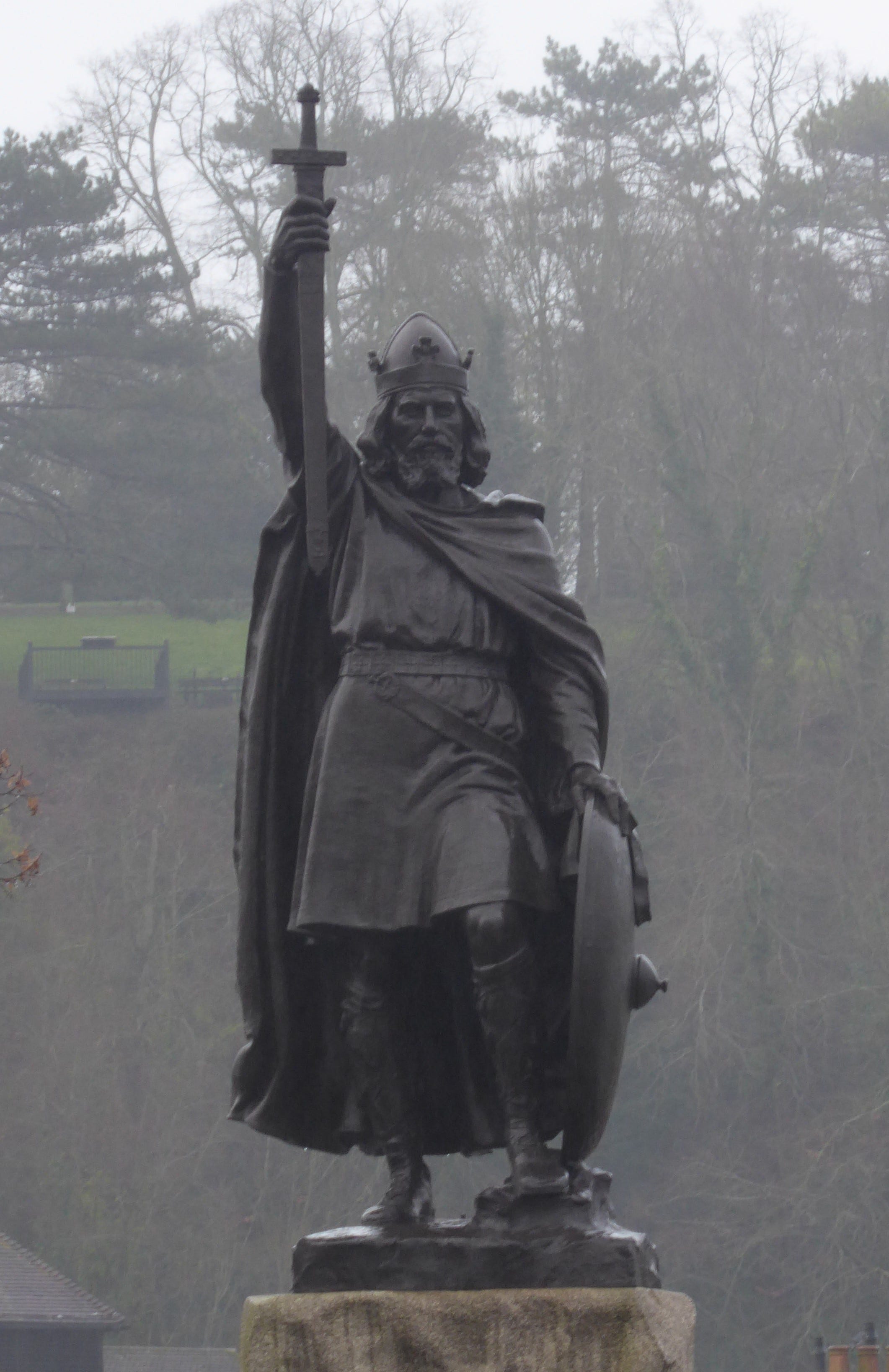
At its eastern end, the High Street opens out onto The Broadway and changes character completely. On one side of The Broadway is the Guildhall which Henry mentions as he enters Winchester. A huge, honey-coloured stone Victorian gothic building with squat brown marble columns at the raised entrance. Opposite this today is the entrance to Winchester’s bus station, flanked by a Coral bookmakers and the Gandhi Indian restaurant. Just beyond these is the frankly massive statue of King Alfred the Great. This statue arrived in Winchester a quarter of a century before HV Morton. It had been commissioned to mark a thousand years since the death of this king of England.
At the opposite end of the High Street is another place associated with kings and, also, the first place that Morton visited in Winchester: the Great Hall of Winchester Castle.
Very little remains of the castle, or castles, that have been built here since William the Conqueror selected the site of the old Roman fort of Venta Belgarum for one of his first fortresses. The Great Hall is most famous for the Round Table and it is this that Morton concentrates on. He accepts that this cannot be the actual round table of King Arthur but is more circumspect on the existence of the king himself.
The great hall is an impressive building, a huge stone-built barn of a place with stained glass windows and, of course, the round table. It still hangs high up on the wall, much as Henry must have seen it, though I imagine it has been re-painted, as it is bright and vivid. In the years since Henry visited, it has been dated as from a tree felled in 1275. Meaning it’s much younger than the Great Hall itself and ludicrously younger than the myth of Arthur. Even if it is an 750 year old table, which is quite impressive all by itself.
Even though he accepts that the round table couldn’t be King Arthur’s, Morton seems to accept that King Arthur himself was the real thing. Like a lot of the things which Morton believes in as being representative of England and the English, the historical facts around the existence of Arthur are dubious. Most people like me, whose education in the Arthurian legend does not extend much further than Monty Python and the Holy Grail, imagine Arthur as a medieval knight in shining armour surrounded by similarly clad knights on white chargers. If there is a real historical basis for Arthur, it sits not in armour and castles but in the late fifth and early sixth centuries.
If there is any basis to the story of Arthur then it would come from the battles of the Britons against invading Saxons. That’s certainly where the ninth century Historia Brittonum places him.
Odd then that earlier works such as Gildas’ sixth century De Excidio et Conquestu Britanniae or Bede’s Historia ecclesiastica gentis Anglorum from the early eighth century fail to mention Arthur at all. Perhaps there were people, leaders, warriors, stories and myths which were the germ of the idea of Arthur. Perhaps he was not one person but one idea, an idea that has grown into something entirely separate from fact. A lot of what we think we know about Britain is probably one part fact to ten parts make believe.
Morton says that “if one were looking for the germ of the British Empire, it is to be found in this quiet little city of Winchester.” Clearly his view of the Empire is unlikely to be in accord with the ones most of us hold today. In 1926, the British Empire was already undergoing significant change from its nineteenth century apogee.
The 1926 Imperial Conference acknowledged the Dominions as “autonomous communities within the British Empire, equal in status” to the United Kingdom. This declaration marked a crucial step towards greater self-governance for these nations, while also adopting the term “Commonwealth” to describe their association. Of course, the conference was held in London.
The conference was attended by delegates from Australia, Canada, India, Newfoundland, the Irish Free State, New Zealand and South Africa. The representatives for India were the Earl of Birkenhead and the Earl of Winterton, neither of whom were, I believe, natives of the subcontinent. You will also notice the lack of delegates from any of the African nations such as Nigeria, Gold Coast, Sierra Leone, Gambia, Kenya, the Uganda Protectorate, Tanganyika, British Somaliland, Rhodesia, Nyasaland, Swaziland or Basutoland which still formed part of the world’s largest empire.
I was once told by an Irishman that the sun never set on the British Empire and the reason for that was that God didn’t trust the fuckers in the dark.
After visiting the Great Hall, Morton visited the cathedral, as he was wont to do. I had paid £9 for a ticket which granted me access not only to the Great Hall but also the Westgate Museum, so I headed there instead. If the Great Hall could, albeit uncharitably, be called one big room, then the Westgate Museum could be summed up in the phrase: “one not very big room”. There are a few exhibits relating to the history of the city and even on a wet Tuesday there are enough visitors to make it feel rather cramped.
My favourite exhibit was of the gown and hat and staff of the City Champion. Apparently this was a role created around 1669 by a group called the Society of Natives of Winchester. The formation of this group, the second best named society in Winchester, was brought about by a desire to relieve the suffering of Winchester natives caused by a recent outbreak of the plague. The group later joined forces with the best named society in Winchester, one of the few societies I’d like to join: the Society of Aliens.
One of the duties of the City Champion was to oversee apprentices. Once a year at a feast, each apprentice would be congratulated or reproved by the Champion depending on his performance during the year. Throughout the year, the Champion was required to bring unruly apprentices into line by thrashing them with the birch.
I move on in the direction of the cathedral via a marvellous independent stationers and branch of Waterstones. I love both stationery shops and book shops. In the former I spend more than I should on yet another propelling pencil. I do not know how many propelling pencils one man might need but I now have a yellow one, too. In the latter I spend no money at all because I still have a book token left over from Christmas. I do, however, leave with a book about the creation of the deHavilland DH60 Moth and another about Britain in the age of Arthur, so that I can learn even more than Monty Python taught me about the king.
When Henry reached the cathedral he joined a tour group. Together with the verger, they climbed the spiral staircase to the roof and looked out over Winchester: the town lying in a blue haze of smoke from its chimneys. Today there are no smoking chimneys, the tree-clad hill just to the east of this compact city is still there with the further bare hills behind. From the roof of the cathedral, Winchester feels as though it sits in a great bucolic bowl.
While you can make out the twentieth century utilitarian brick boxes which are scattered through the town and the multi-storey car park of the King’s Walk Shopping Arcade, the view across the cathedral close and tiled rooves and tall spires would be one that Henry Morton would have recognised because you can’t quite make out the M3 motorway. He too would have seen the old bishop’s palace and the buildings of Winchester College. This grand and impressive school, founded in 1382, has educated some grand and impressive people and Rishi Sunak.
After his time atop the cathedral, Henry says that he met a tattered man by the side of the road. Of course, I don’t believe a word of it. Mr Morton quite often comes across just the right person at just the right time and I believe him in less than ten percent of cases. However, this tattered man leads him to his next destination: The Hospital of St Cross and Almshouse of Noble Poverty.
It’s still there today, and as I arrive, the last traces of rain clear and a shaft of sunlight bathes the medieval walls of the Hospital. A little lane leads to the Tudor arched entrance gate. Beyond this is a small courtyard which nowadays houses a tearoom offering a fine looking lemon and blueberry cake (two of your five a day, it’s important to stay healthy when travelling). I hadn’t met a tattered man but I did meet a man sizing up the parking space available for his Austin Healey which he was due to bring to the Michaelmas Fair in September.
Then I pass under another arch in a three-storey stone-built gatehouse and into the Hospital itself. This being Winchester, we’re never far from kings and bishops. In this case it is King Stephen – he of the rhyme: Willie, Willie, Harry, Ste – and his brother, Bishop of Winchester, Henry of Blois. Their dad, Stephen, Count of Blois and Chartres, got a leg up as well as a leg over when he married Adela, youngest daughter of William the Conqueror. They had eleven children of which Henry was the tenth. They had run out of ideas for occupations for sons by then and so sent him off to become a monk.
Still, it’s not what you know, it’s who you know and having an uncle called King Henry the First can’t have hurt his career. Uncle Harry made him Abbot of Glastonbury in 1126 and three years later, at the age of thirty-three, Bishop of Winchester. There is a legend that while walking in the water meadows to the south of Winchester, Bishop Henry met a milkmaid who told him of the poverty of many local people. Being a bishop, son of a count and brother of the king, poverty was not necessarily something he’d have been particularly aware of until then.
Mind you, he decided to do something about it and founded the Hospital of St Cross in the mid-1130s. He did so to help the poor and sick but also “for the good of his soul, and those of his predecessors and the kings of England”. A wily fellow, then, ensuring good treatment both in this life and the next by telling the king he’d done it for the good of his soul and by doing something charitable which he hoped would be in his favour when he met St Peter at the gates. The hospital was established to help:
“Thirteen poor men who are so feeble and lacking in strength that they can scarcely if at all look after themselves without the help of others. They are to live constantly in the said Hospital, the necessary clothing being provided for them by the head of the said house and suitable beds for those who are ill. Each day they will receive a loaf of good wheat bread weighing five measures, three dishes for dinner and one, appropriate to the day, for supper, and sufficient drink.”
Well, that doesn’t sound like a bad life. Bishop Henry also provided for up to a hundred others to be given a free lunch and a free beer. It was a pretty amazing thing to do. What is most amazing of all is that not only is part of the church which still stands here a remnant of the twelfth century one, but the Hospital still provides a place for those in need. The almshouses, which were built in the 1440s, house up to twenty-five men over the age of sixty-five. Up to seventeen can be Brothers of The Hospital of St Cross and a further eight may be Brothers of the Order of Noble Poverty.
The Brothers’ quarters are on my right as I pass through the three-storey gatehouse and into the main quadrangle of the Hospital. The quarters are a long, stone built, two-storey building with small windows, a red-brown tiled roof and tall chimneys. Opposite this is the ambulatory, an open passageway with a beamed upper storey above.
Next to the gatehouse is the Brethren’s Hall, opposite these is the Church of St Cross. None of that gives you even the merest hint of how magnificent, magical and peaceful this place is. If Winchester is wonderful, and it is, then it is hard to find words to tell you how untouched and untroubled this cluster of medieval buildings on the edge of the water meadows to the south of the city centre seems.
A man can apply to become a Brother if he is over state retirement age, no longer employed, and single, divorced or a widower. Each Brother has a self-contained flat, consisting of a sitting room, bedroom, shower, kitchen and separate lavatory. Those Brothers who have financial resources in addition to the State Pension then make a contribution based on their income. The Brothers do not belong to a religious order, but are expected to wear their gowns - black for the Brothers of the Hospital of St Cross, maroon for the Brothers of the Order of Noble Poverty - to attend morning prayers in the Chapel daily at 10 am.
When Henry Morton came here in 1926, he says that there was “a waiting list as long as your arm” for membership of the brethren and entrance to the quarters here. The porter today tells me that at present several of the apartments are empty as they are renovating them to bring them up to modern standards.
I am neither of state pension age nor single but, if I were, my name would be on the list today. To spend your last years here would be incredible and the porter told me that some brothers had been here more than twenty years. What a wonderful way to while away the days when life’s work is done.
The possibly fictional tattered man who led HVM here was in search of the Wayfarers’ Dole of bread and beer. Long before 1926, Bishop Henry’s free lunch for a hundred had become a chunk of bread and a measure of beer served in a horn mug. The tattered man had his and then Henry Morton, too, asked for the Wayfarers’ Dole.
A century later, I asked the porter for the dole and received an inch square of bread and a small paper cup of beer. Things change here but they don’t change that much. As I leave, I meet Edward, a trainee vicar who is spending a month here as part of his training. Perhaps he is the tenth son of a count, it wouldn’t surprise me.
After Winchester, Henry told tales of Romsey, Southampton, Beaulieu and Buckler’s Hard. So, I suppose that I should do the same. See you next week.